
Roof Rat Biology & Structural Nesting Behavior in Friendswood
Roof rats (Rattus rattus), also known as black rats or ship rats, are the primary invasive rodent species responsible for attic infestations across the Greater Houston Bay Area. Characterized by slender black or dark brown bodies, large hairless ears, pointed muzzles, and tails that extend significantly longer than their combined head and body length, roof rats are agile climbers naturally adapted to arboreal life.
In Friendswood, neighborhoods with mature tree canopies, such as Wilderness Trails, The Forest, and Polly Ranch Estates, provide an ideal ecosystem. Roof rats use overhead branches from live oaks, pecans, and loblolly pines to access residential rooflines without ever touching the ground. Once they reach the roof, they exploit microscopic builder gaps, chewed lead plumbing boots, and rotted fascia boards to establish extensive nesting chambers inside blown-in fiberglass attic insulation.
Understanding the anatomical and biological capabilities of roof rats is essential to executing permanent structural exclusion.
Anatomic Profile & Species Identification Metrics
| Diagnostic Feature | Roof Rat (Rattus rattus) | Norway Rat (Rattus norvegicus) | House Mouse (Mus musculus) |
|---|---|---|---|
| Adult Weight | 5 to 10 ounces (slender) | 10 to 18 ounces (heavy, stocky) | 0.5 to 1 ounce (very small) |
| Body Length | 6 to 8 inches | 7 to 10 inches | 2.5 to 3.5 inches |
| Tail Length | 7 to 10 inches (longer than body) | 6 to 8 inches (shorter than body) | 3 to 4 inches |
| Ear Size | Large, prominent, hairless | Small, close-set, hairy | Moderate, rounded |
| Dropping Shape | Banana or capsule-shaped, pointed ends (0.5 inch) | Blunt, spindle-shaped, rounded ends (0.75 inch) | Tiny, rod-shaped, pointed ends (0.25 inch) |
| Preferred Habitat | Upper attics, rooflines, trees | Subterranean burrows, crawlspaces | Kitchen pantries, base of walls |
| Feeding Preference | Seeds, berries, nuts, fruit | Meats, grains, garbage | Grains, cereals, seeds |
Why Roof Rats Prefer Texas Gulf Coast Attics
Friendswood’s climate and coastal geography offer roof rats a unique survival advantage:
- Abundant Overhead Food Canopy: Mature live oak acorns, sweet gum seed balls, citrus trees, and backyard pecan trees provide year-round protein and fats.
- Thermal Stability in Winter: Although Texas winters are generally mild, sudden arctic cold fronts drop temperatures below freezing. Heated residential attics act as thermal magnets, drawing roof rats inside through eaves.
- Summer Water Seeking: During peak summer heat in July and August, when local bayous run low, temperatures inside unventilated attics can exceed 140 degrees. Roof rats migrate down into wall voids and chew into plastic PEX plumbing lines and AC condensation pipes to drink water.
Structural Damage Caused by Roof Rats
- Chewed Electrical Romex Wiring: Rodents possess continuously growing incisors that require daily gnawing to keep filed down. Roof rats chew through the outer PVC jacket and inner thermoplastic insulation of 12-gauge and 14-gauge household wiring, leaving exposed bare copper that sparks attic fires.
- Insulation R-Value Degradation: Rats tunnel through blown-in fiberglass insulation, compressing it down to bare drywall. Over six months, a colony can destroy the thermal insulation of an entire ceiling bay, dramatically raising monthly air conditioning bills.
- Flexible HVAC Ductwork Destruction: Roof rats chew directly through flexible insulated duct jackets to nest inside the cool fiberglass lining. They deposit urine and droppings inside the air plenum, blowing contaminated air into bedrooms every time the AC blower kicks on.
Permanent Roof Rat Exclusion & Trapping Protocol
At Friendswood Rodent Shield, we follow a strict three-stage protocol to eliminate roof rats permanently:
- Tree Canopy Clearance Advice: We advise property owners to trim all branches back at least 8 to 10 feet from the roofline to disrupt overhead travel highways.
- Poison-Free Mechanical Trapping: We place high-impact expanded-trigger snap traps directly along attic travel runways and joist tops. We never deploy poison baits indoors.
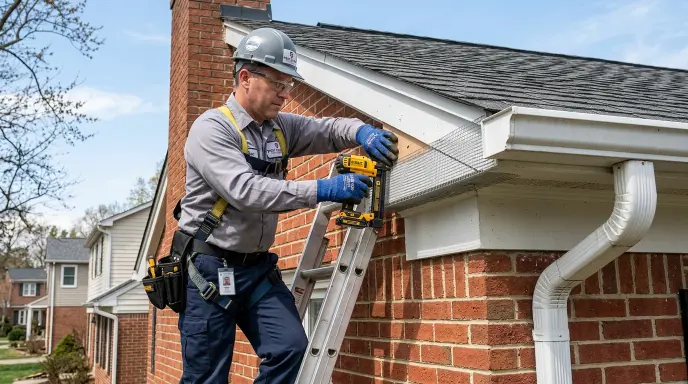
- Heavy-Gauge Steel Exclusion: We install 1/4-inch 23-gauge galvanized hardware cloth along builder gaps, cap roof vents with custom steel covers, and seal all exterior fascia gaps with chew-proof elastomeric sealants.
Arboreal Highway Mechanics: Live Oak Canopy Bridge Dynamics
In mature Friendswood subdivisions such as The Forest, Polly Ranch Estates, and Wilderness Trails, roof rats exploit live oak (Quercus virginiana) and pecan tree canopies that hang within 8 to 12 feet of residential roof shingles. Roof rats possess exceptional balance, utilizing their long, scaly tails as counterweights while sprinting along swaying branches, utility drop cables, and fence top-rails.
When tree branches contact or overhang a roofline:
- Thermal Updraft Attraction: During cool autumn and winter evenings, warm air escaping through attic ridge vents and soffits creates an upward thermal plume that roof rats detect from over 30 feet away.
- Direct Roof Shingle Access: The animals leap onto composite shingles, bypassing all ground-level bait stations or perimeter inspections conducted by traditional exterminators.
- Gutters as Runways: Once on the roof, rats use metal gutters as concealed perimeter highways, running along the roof perimeter until they locate a builder gap or chewed lead plumbing boot.
Incisor Dental Wear Dynamics & Chewing Imperative
A biological characteristic of Rattus rattus that creates severe structural danger is their pair of continuously growing, chisel-like incisors. A roof rat’s incisors grow at an astonishing rate of 4 to 5 inches per year.
To prevent these teeth from overgrowing into their skulls, rats must gnaw relentlessly against rigid materials:
- Mohs Hardness Capability: Rat dental enamel measures 5.5 on the Mohs hardness scale. This makes their teeth harder than lead (1.5), aluminum (2.5 to 3.0), copper (3.0), and standard pine framing lumber.
- Vulnerable Building Materials: Roof rats chew cleanly through lead roof plumbing jacks, vinyl soffit panels, heavy PEX water supply lines, and electrical Romex insulation.
- Impenetrable Barrier Requirements: Only high-tensile carbon steel, hot-dipped galvanized steel hardware cloth (23-gauge or heavier with 1/4-inch mesh), and copper wire mesh resist rat dental erosion.
Reproduction Cycles & Exponential Colony Expansion
Roof rats reach sexual maturity within 8 to 12 weeks of birth. In climate-controlled Friendswood attics, breeding occurs year-round without seasonal hibernation:
- Litter Frequency: A single adult female produces 4 to 6 litters per year.
- Litter Size: Each litter yields between 6 and 8 pups.
- Mathematical Progression: An unaddressed pair of roof rats entering an attic in September can theoretically generate a colony exceeding 40 to 60 individuals by the following summer.
This exponential reproduction rate explains why passive trapping without structural exclusion fails. If exterior roof gaps remain open, outside rats continually replace captured rodents.
Local Friendswood Live Oak Management Guidelines
To support structural exclusion, homeowners should execute tree maintenance:
- The 10-Foot Clearance Rule: Prune all tree branches to maintain at least 10 feet of clear clearance from shingles and exterior walls.
- Utility Cable Collars: Install smooth poly plastic cones on overhead utility lines where power or internet cables enter fascia boards.
- Fruit and Acorn Sanitation: Clear fallen pecans, sweet gum balls, and citrus from turf weekly to deny supplementary fats.